Interception obligations depend on the country and on the number of users.
Even below the thresholds for a permanent capability, operators must still carry out individual orders, which without a built-in capability means copying mailboxes by hand.
Internet service providers, hosting companies and national mail providers can be legally required to intercept the email of specific users when a court or authority orders it. The Lawful Interception add-on implements that obligation inside Stalwart.
Orders and targets are managed under a dedicated role.
Messages and session events are captured as they happen.
Results are handed over to the authorities in the formats defined by the European Telecommunications Standards Institute (ETSI).
Stalwart Labs assists operators through national approval.
Interception obligations depend on the country and on the number of users.
Even below the thresholds for a permanent capability, operators must still carry out individual orders, which without a built-in capability means copying mailboxes by hand.
Email providers with more than 100,000 users must maintain interception capability (§ 170 TKG with § 3(2) of the Telecommunications Interception Ordinance, TKÜV), and users of hosting partners on the same system count towards the threshold. The technical directive TR TKÜV requires handover per ETSI TS 102 232-1 and -2, the implementation is checked by the Bundesnetzagentur (Nachweis), and handover runs over IPsec through a secunet SINA Box.
The interception obligations of a technical capability notice under the Investigatory Powers Act 2016 apply to operators providing services to more than 10,000 persons (Investigatory Powers (Technical Capability) Regulations 2018).
Most European countries impose comparable obligations on providers of electronic communication services, with national handover requirements based on ETSI standards.
Every interception starts from a legal order.
The Lawful Interception add-on records each order with its reference, the requesting authority, its targets and its validity period, and activates, changes or ends interception on its schedule. An order can be activated as soon as a copy is received, and ended early at the authority's request. Several authorities can intercept the same target at the same time without being aware of each other.
Targets can be identified by email address, including internationalised addresses, by login name or by client IP address, and Stalwart resolves them across aliases, catch-all addresses, forwarding and shared mailboxes, so no message reaches the target through a route the order did not name.
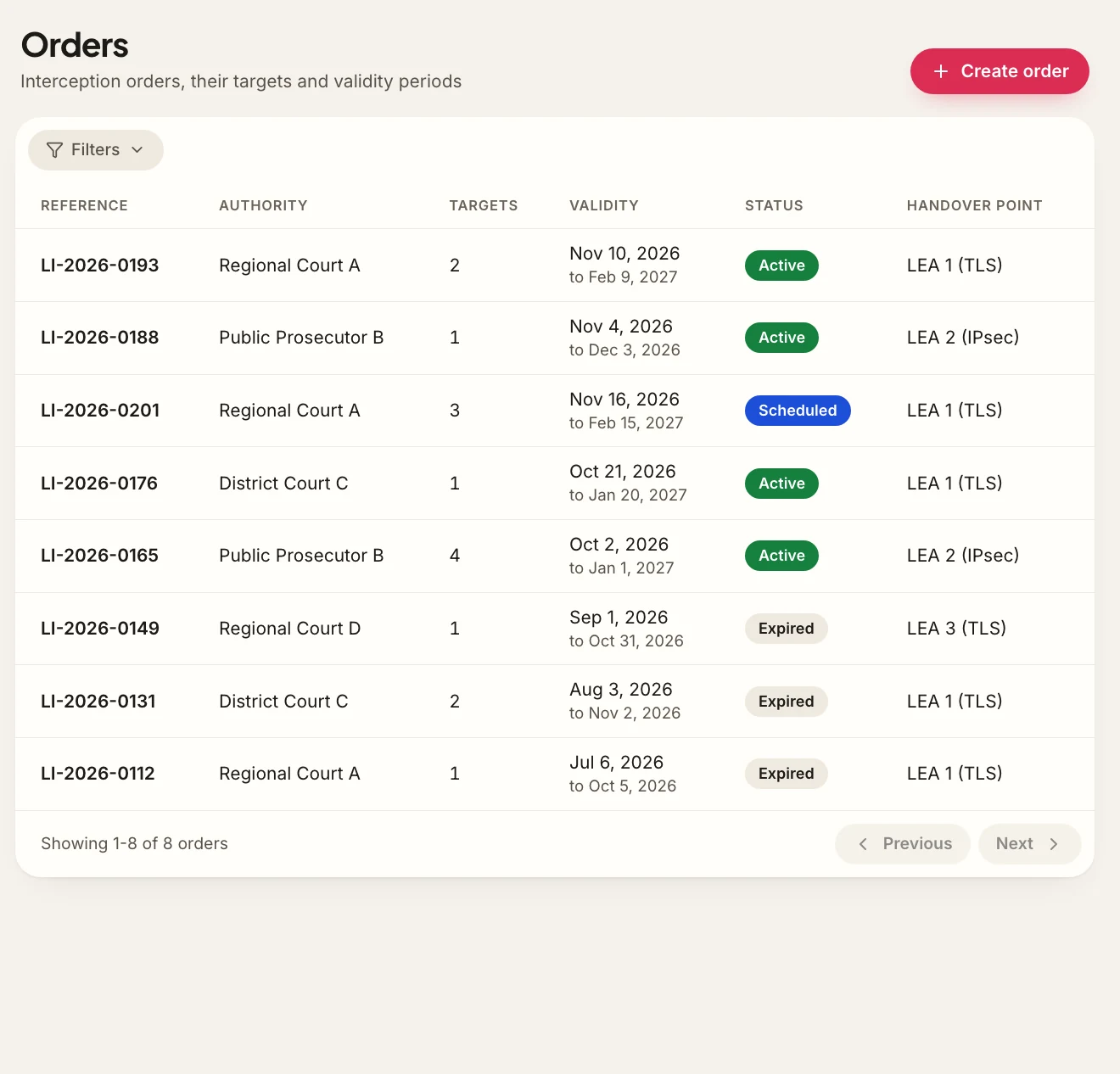
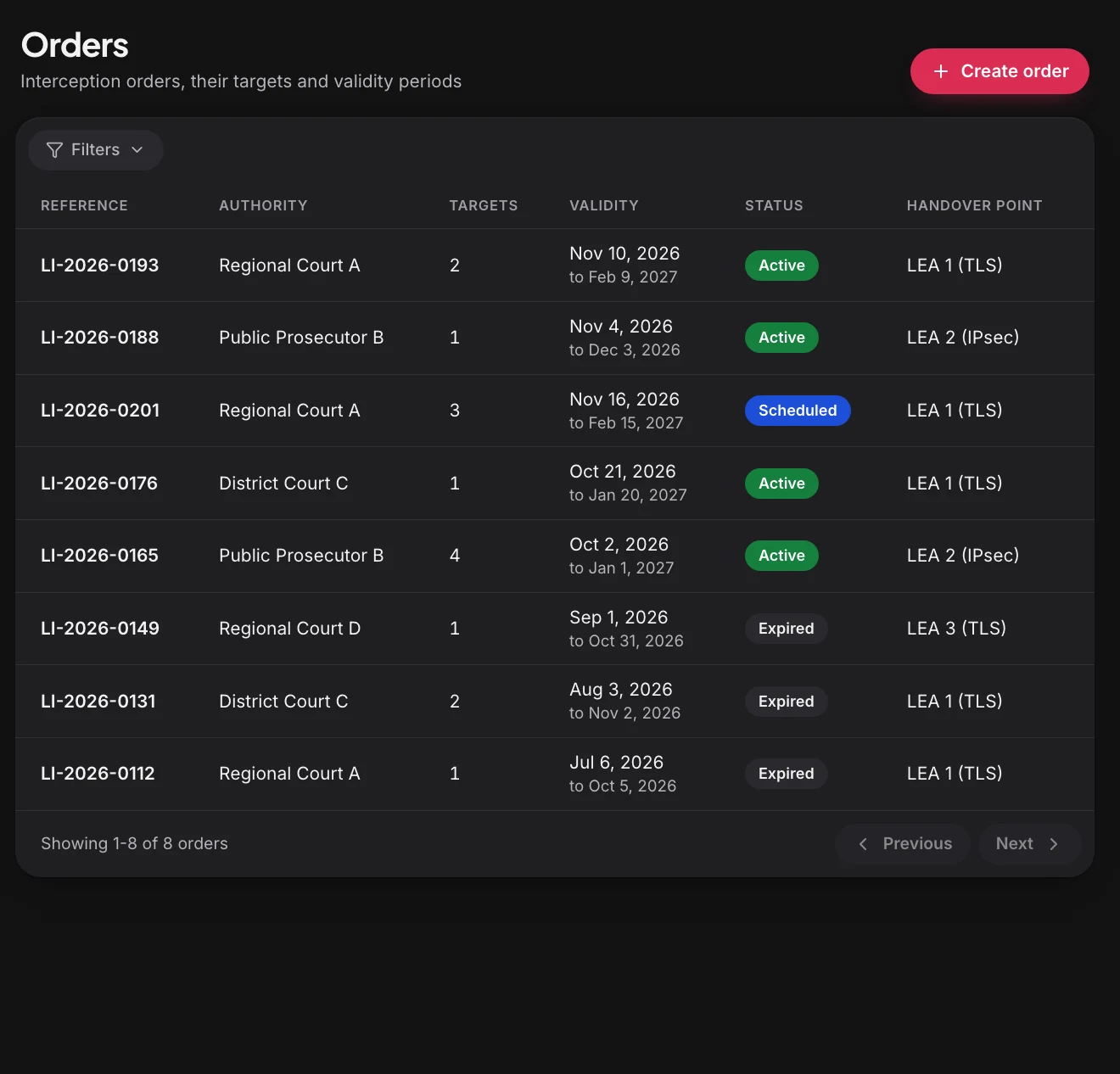
Once an order is active, Stalwart captures what the order covers as it happens: every message the target sends or receives, and every session in which the target logs in, reads, downloads or stores mail.
Content is the complete message with its SMTP envelope, and the related data (the intercept-related information, or IRI) records who communicated with whom, when, from which address and with what result. Orders that cover related data only are supported. Capture happens inside the server, on every node of a cluster, so nothing changes for the target: no delay, no altered headers and no visible trace.
The LI Handover add-on delivers intercepted content and related data to the authority's mediation or recording equipment, using the ETSI handover standards for IP-based services; in Germany, delivery runs over IPsec through a SINA Box.
Records are encoded as ETSI TS 102 232-1 protocol data units (PDUs) carrying the TS 102 232-2 messaging service records, over TLS or IPsec. Delivery is reliable: records are buffered when the connection to the authority is down and sent in order once it returns, with keep-alive and test messages to confirm the link is working.
Each handover point is configured separately, so one deployment can deliver to several authorities or countries.
Interception must be invisible to the target and to everyone without a need to know, and every use of it must be accountable.
Orders, targets and intercepted data are accessible only to the lawful interception officer role, which is separate from server administration. Through Stalwart's administration interfaces, administrators cannot see which accounts are targeted, how many orders are active or how they are implemented. Every action is logged without gaps, including tests and incorrect entries: the order reference, the target identifier entered, the person who entered it and when, the period during which data was captured and the authority it was delivered to.
The people who operate interception cannot read, change or delete that log, and its records are kept for the periods national rules require.
Having the capability is only part of the obligation: it must be documented, tested with the authorities and, in some countries, formally approved.
Stalwart's interception implementation follows TR TKÜV, and its type-sample test by the Bundesnetzagentur (Typmusterprüfung) is in process; once completed, operators will be able to refer to the result in their own Nachweis. Stalwart Labs also offers lawful-interception compliance assistance as a professional service.
Stalwart Labs provides the software and the assistance.
The legal obligation, and the day-to-day work that comes with it, stays with the operator.
No. Lawful Interception is available for Stalwart On-Premise only, where the operator of the deployment holds the interception obligation.
No. The Lawful Interception add-on runs inside the operator's own deployment, and intercepted data goes directly from the operator's servers to the authority.
Interception captures communications from the moment the order is activated. Requests for stored subscriber and traffic data are a separate obligation, handled through the TS 102 657 interface of the LI Handover add-on.
Targets are resolved across every tenant of the deployment, so users of resellers and hosting partners can be intercepted by the operator that runs the system, without the tenant administrators being aware of it.
Journaling keeps a copy of an organisation's own mail for its own records, and is known to its users. Lawful interception captures the communications of specific targets named in a legal order, conceals the capture from everyone except the lawful interception officer, and delivers the result to an authority in a standardised format.
Only if the authorities in your country require delivery through an ETSI handover interface. Without it, the Lawful Interception add-on captures and exports the data for each order, which is enough where authorities accept another form of delivery.
Yes. Several orders can cover the same target, each with its own authority and handover point, and none of them is visible to the others.
Lawful Interception is licensed on top of the Enterprise subscription, and LI Handover per handover point. Compliance assistance is quoted separately. A quote and a pro-forma invoice can be obtained from the licensing portal.